Thursday, 19 March 2026
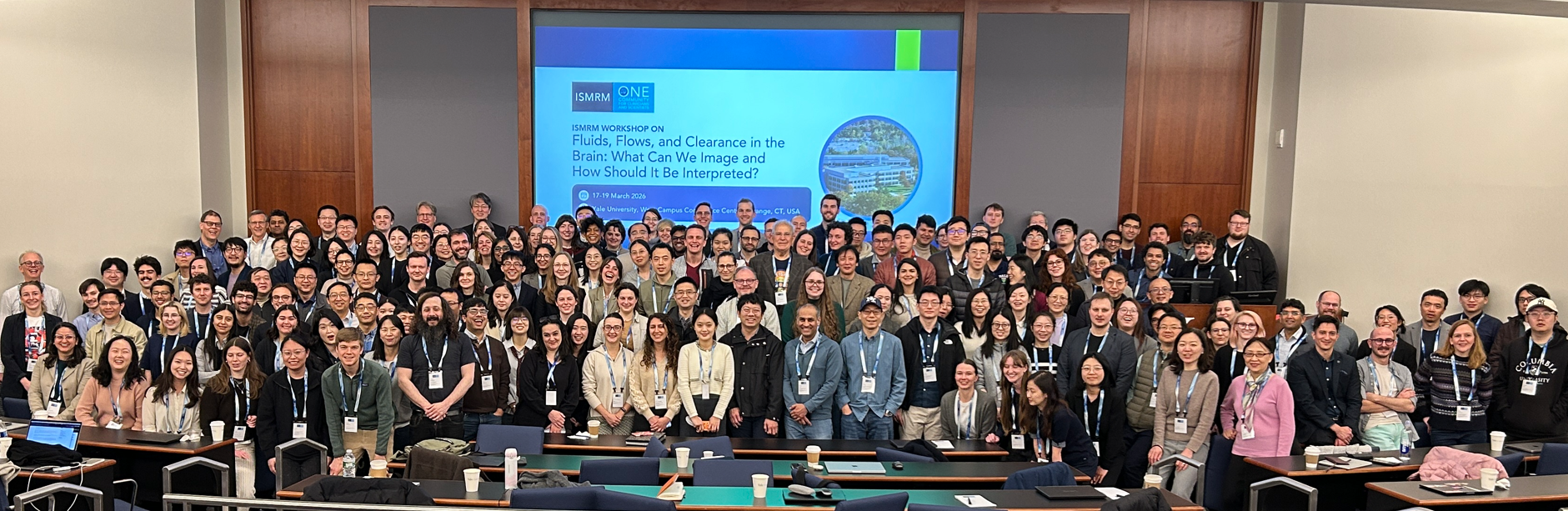
Thank you all who attended the ISMRM Workshop on Fluids, Flows, and Clearance in the Brain: What Can We Image and How Should It Be Interpreted? and for making it a success!
----------------------------------------------------------------------------------------
Workshop Overview
This workshop will discuss the current state of the art of MRI techniques for measuring neurofluids (dynamics of blood and cerebrospinal fluid (CSF) in the brain), and how the images from these techniques should be interpreted and applied to patients with clinical disorders. Sessions will include a focus on novel methods in phase contrast MRI, functional MRI, ASL, diffusion, and motion-sensitive MRI techniques, and how these techniques can be rigorously validated and accurately interpreted. Sessions will describe the current knowledge about the physiology of CSF flow in the brain at multiple spatial scales, and its links to waste clearance and lymphatic systems. We will discuss many clinical applications of these methods, including in traumatic brain injury, Alzheimer’s disease, sleep and sleep disorders, pediatrics, hydrocephalus, and aging. We will include a practical hands-on session on how to analyze several types of MRI data focused on neurofluid measurement. We will also include a session on open-source data and tools, to enable attendees to begin working with these methods on their own. This workshop provides technical insight, practical knowledge, and clinical context for imaging and understanding CSF and waste clearance systems in the brain.
Target Audience
This workshop will be relevant for radiologists and neurologists. MRI technologies are now beginning to be able to measure fluid dynamics and waste clearance in the human brain. These techniques have revealed striking changes in neurofluids linked to neurodegenerative disorders such as Alzheimer's disease, cerebral amyloid angiopath, and traumatic brain injury. Furthermore, clinical interventions are now being developed based on these methods. Being up to date on the current MRI methods and their clinical applications will be relevant for multiple clinical practice areas.
Educational Objectives
Upon completion of this activity, participants should be able to:
- Demonstrate current MR imaging methods to probe the brain clearance system and neurofluid physiology;
- Examine what component(s) of the brain clearance system current MR imaging techniques are sensitive to;
- Evaluate limitations (what is not measured) of current brain clearance and fluid imaging methods;
- Describe the anatomy and physiology of brain clearance pathways;
- Explain the different theories on brain clearance both regarding common elements as well as still-disputed components;
- Assess how diseases affect brain clearance as well as MRI of brain clearance and neurofluid physiology;
- Identify gaps in our current MRI arsenal for monitoring brain clearance; and
- Identify current barriers for widespread dissemination of brain clearance MRI.